Google Cloud Build
Setting up Google Cloud Build as a Continuous Integration (CI) system within Spinnaker allows you to:
- trigger pipelines when a GCB build completes
- add a GCB stage to your pipeline
Prerequisites
GCP project
You need to have a
Google Cloud Platform
project with the
Cloud Build API
enabled.
You can enable the API with the following gcloud command:
gcloud services enable cloudbuild.googleapis.com
Pub/sub subscription
Google Cloud Build sends Build Notifications when the state of your build changes. Spinnaker subscribes to these pub/sub messages so that it can…
- track the status of builds it has initiated in a GCB stage
- trigger pipelines based on build status changes
Create a Subscription object for the cloud-builds topic in your project:
    PROJECT_ID=
    SUBSCRIPTION_NAME=spinnaker-cloud-build

    gcloud pubsub subscriptions create $SUBSCRIPTION_NAME \
      --topic projects/$PROJECT_ID/topics/cloud-builds \
      --project $PROJECT_ID
Service account
Finally, you will need a service account that has both Cloud Build Editor and Pub/Sub Subscriber permissions.
The commands below look for the service account key in a path/file defined in $SERVICE_ACCOUNT_KEY.
Configure Spinnaker to work with Google Cloud Build
Make sure that you have locking enabled on igor
This will allow you to run multiple igor pods while NOT triggering duplicate
executions. Make sure you have the following entry in your igor-local.yml file:
locking:
  enabled: true
Enable pub/sub
Read through and enable pub/sub integration with google . This should cover setting up google to send notifications that spinnaker will consume.
Configure the spinnaker services
You’ll want to add the following to consume GCB messages:
User interface
Add the following to your deck settings-local.js file to enable
the UI around pub/sub.
window.spinnakerSettings.feature.ci = true;

// add other trigger types to show as needed.
window.spinnakerSettings.triggerTypes = ["cron", "pubsub"]
For a more complete list of UI options, see the deck settings file
Event processing
In echo (the event system) add the following config to echo-local.yml
will enable subscriptions to events.
gcb:
  enabled: true
  accounts:
  - name: accountName
    project: projectID
    subscriptionName: subscriptionForGCBEvents
    jsonKey: ifNeeded
GCB invocation
In igor (the CI build handler) add the following to igor-local.yml
gcb:
  enabled: true
  accounts:
  - name: accountName
    project: projectID
    cloudBuildRegion: <optional>
    jsonKey: authCredsIfNeeded
You’ll note that the fields are similar to echo, but missing the subscription name. Each service is responsible for different purposes. Echo handles notifications FROM GCB, while igor handles requests to INVOKE GCB builds. Orca (the execution engine) will call igor to get a list of accounts and make requests to GCB.
Regional Cloud Build (Private Pools)
If you are using a
private pool
in a region other than us-central1, you need to configure the cloudBuildRegion for your GCB account.
GCP uses regional endpoints for non-default private pools.
Add the regional configuration directly in your Igor profile (~/.hal/default/profiles/igor-local.yml):
gcb:
  enabled: true
  accounts:
    - name: dev
      project: my-project-id
      subscriptionName: spinnaker-cloud-build
    - name: dev-us-east1
      project: my-project-id
      cloudBuildRegion: us-east1
      subscriptionName: spinnaker-cloud-build-us-east1
Important: Each regional account requires its own Pub/Sub subscription to avoid race conditions between accounts when processing build notifications.
Configure your pipeline trigger
Configure your pipeline to be triggered by a completed GCB build:
-
In your Pipeline configuration, click the Configuration stage on the far left of the pipeline diagram.
-
Click Automated Triggers.
-
In the Type field, select
Pub/Sub. -
In the Pub/Sub System Type field, select
google. -
In the Subscription Name field, select your
$ACCOUNT_NAMEvalue. -
In the Attribute Constraints field, enter
statusin the Key, andSUCCESS(all upper case) in the Value field. -
In the Payload Constraints field, you can enter any of the top-level fields from the Build object documentation as the key, and a Java regular expression as the value.
-
In the Expected Artifacts field, you can add any build artifacts as expected artifacts. For example, if the build produces a Docker image, you can add an expected artifact of type Docker with a value of
gcr.io/my-project-id/my-application(replacingmy-project-idandmy-applicationwith appropriate values). You can then use the produced image in downstream stages.
Configure a Google Cloud Build stage
To run a GCB build as part of a Spinnaker pipeline:
-
create a stage of type Google Cloud Build.
-
Configure the stage by selecting the GCB account to use to run the build, and entering the build configuration YAML in the provided text box:
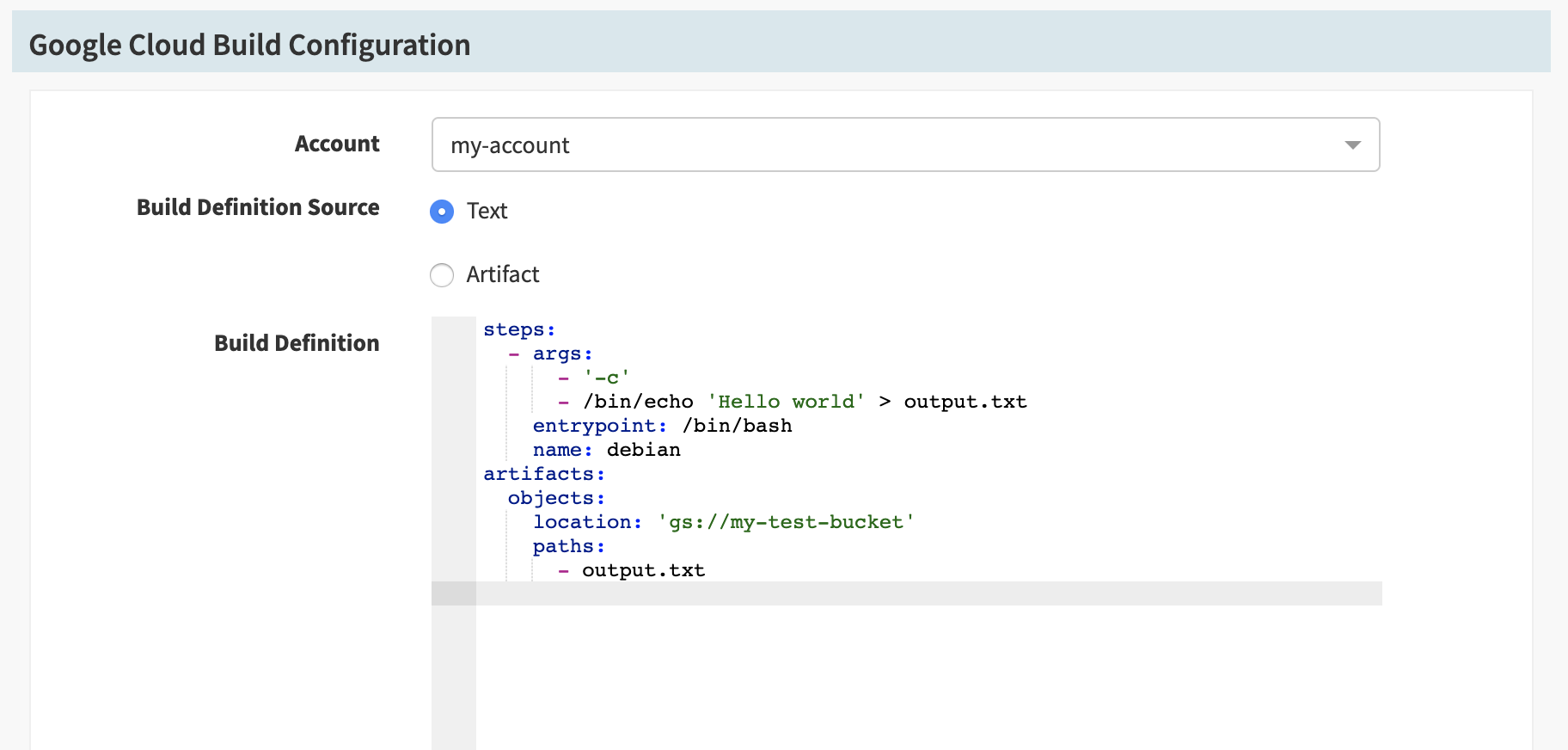 You may also provide the build definition YAML as an artifact.
 -
In the Produces Artifacts section, you may supply any artifacts that you expect the build to create in order to make these artifacts available to downstream stages. Google Cloud Build supports creating either GCS or Docker image artifacts , either of which will be converted to Spinnaker artifacts and injected into the pipeline on completion of the build.
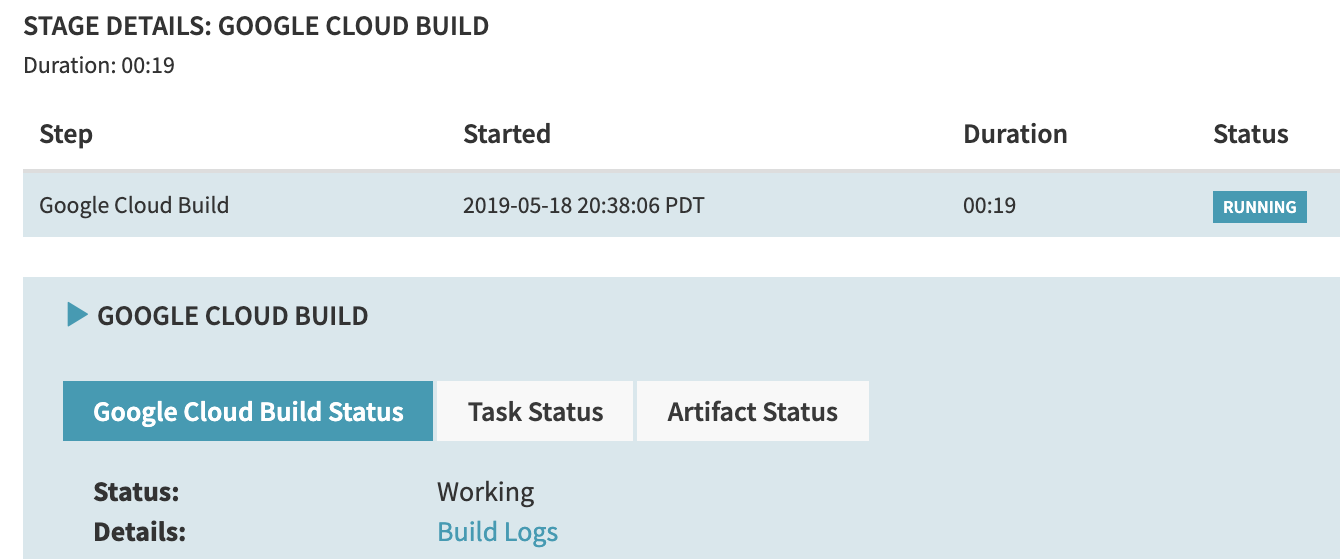
While your build is executing, the stage details will provide the current status of the build and a link to view
the build logs in the Google Cloud Console: