Enable Pipeline Templates
Enable the pipeline templates feature in Spinnaker.
You can share these templates with your teams within a single application, across different applications, or even across different deployments of Spinnaker itself.
Templates can be managed using
spin
or the UI. To manage templates through the UI, enable the requisite feature flag: hal config features edit --managed-pipeline-templates-v2-ui true
The following diagram illustrates one common workflow for Managed Pipeline Templates (MPT v2). Depending on your deployment, enabled features, and tooling, the lifecycle may vary. For example, Sponnet is optional, and templates may be authored or managed using different tools.
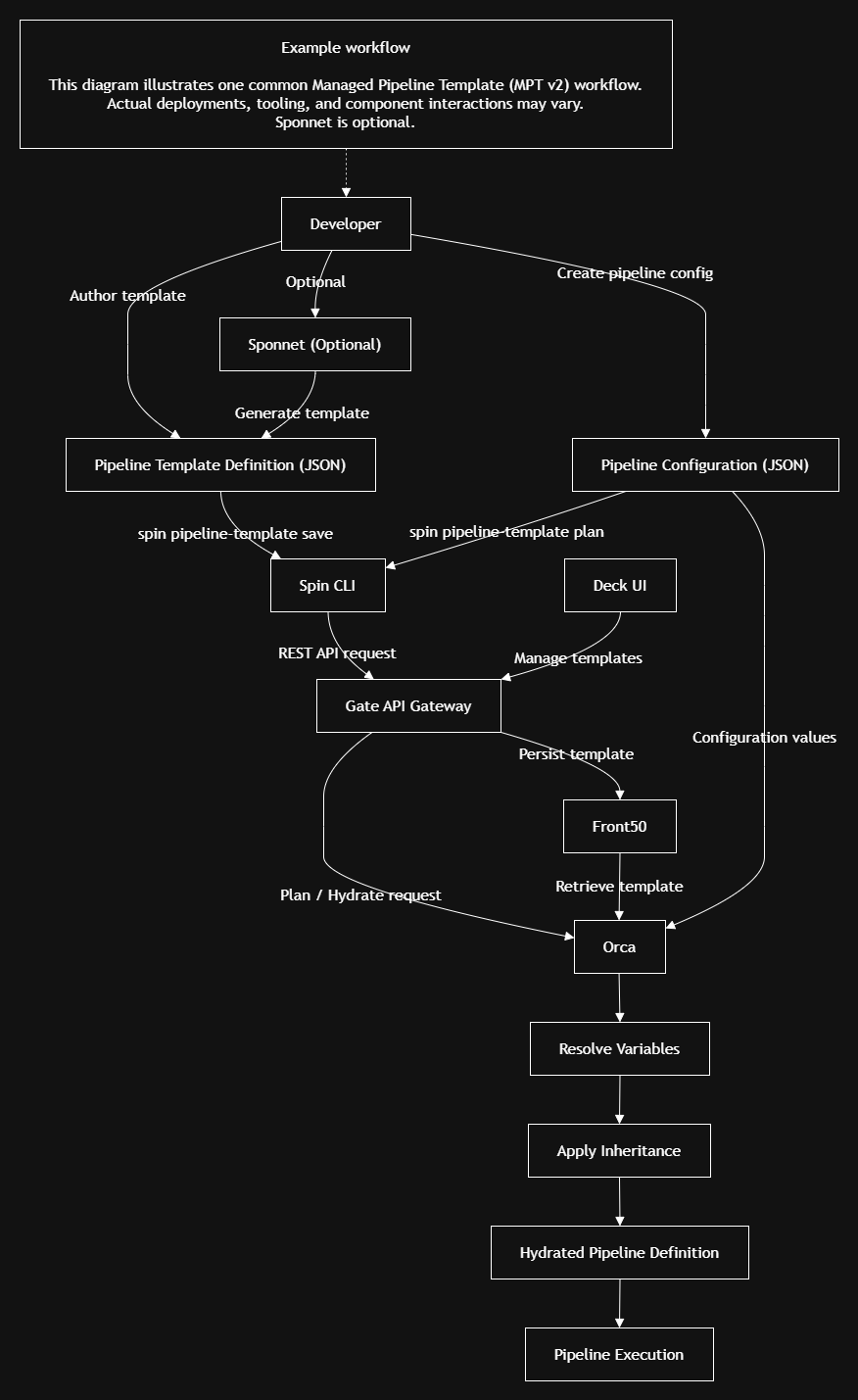
This diagram is intended as an illustrative example rather than the only supported architecture. In this example, templates are authored directly or generated using Sponnet, managed through the Spin CLI or Deck UI, stored through Gate and Front50, hydrated by Orca, and ultimately executed as pipelines.
Before you begin:
The underlying structure of a pipeline template is very close to the pipeline JSON configuration format, viewable in the Deck UI. But it includes information about the variables the template uses.
Create a template based on an existing pipeline.
Share the template with one or more teams of developers using Spinnaker.
Save a pipeline template to Spinnaker to make it available to developers.
[Use the Spin CLI to plan how to parameterize the template]({< ref “/docs/guides/user/pipeline/pipeline-templates/plan” >}}) by visualizing a hydrated pipeline.
Override template definitions in your pipeline.
Enable the pipeline templates feature in Spinnaker.
Create and parameterize a pipeline template from an existing pipeline.
Inherit or override template features in your pipeline.
Create pipelines based on a template.
Visualize a pipeline created from a pipeline template without actually instantiating one.